About the project
The Ouse Valley Solar Farm is a local renewable energy project developed by Ovesco, a community energy organisation based in Lewes. Using solar photovoltaic (PV) technology, which converts sunlight directly into electricity, the solar farm would generate around 17 MW of clean energy, enough to power more than 4,000 homes. That electricity would be fed into the National Grid using the specialist equipment needed to convert and manage the power safely and reliably.
The solar farm will be owned by the members of a Community Benefit Society, including local residents and ethical investors who support community energy. Once operational costs are covered, all surplus profits support a community benefit fund, guided by the membership.

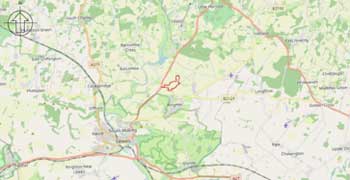
North of Norlington Lane, Ringmer

Indicative Solar Farm Site Outline
How It Works – The Ovesco Model
The solar farm that Ovesco is helping to build will be owned by an independent community benefit society. Local people are invited become members by investing in the solar farm. Once the farm has covered its costs and starts generating profit, the excess profit will go into a community benefit fund, which supports local projects.
Here’s more detail on how the model works:
Every solar farm is its own community company
Each Ovesco project is owned by the members of a separate, stand-alone organisation or special purpose vehicle (SPV) as a community benefit society (CBS) registered with the Finical Conduct Authority (FCA). This is required for legal and technical reasons and ensures:
- strong financial governance
- clear accountability
- the use of an asset lock to safeguard the community investors and prevent selling the project for private gain
This approach also means every project allows for locally ownership, with excess profits ring-fenced for the community it serves.
Community Benefit
Local people are at the centre of the project
Once the solar farm is built and begins returning a surplus, the members can have a say in how profits are used.
Shareholders have equal voting rights, can be voted onto the board of directors and have a vote at an annual AGM on how the company operates. This isn’t a commercial developer. It’s your energy project.
Where the profits go
Just like other Ovesco projects, the Ouse Valley Solar Farm is expected to generate a community benefit fund, which will support local energy and environmental projects.

Community group installing bird boxes, bat boxes and swift tower at a local solar farm
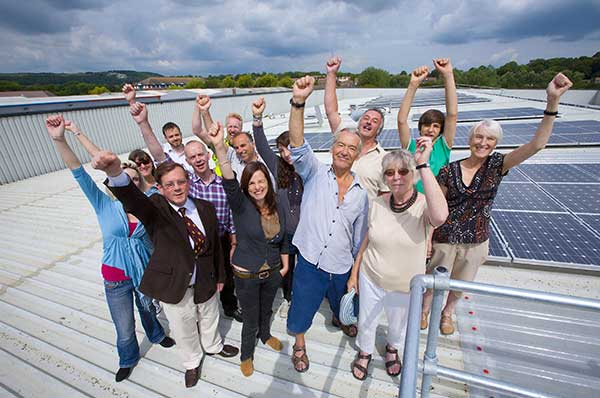
Community group at a local solar farm
Benefits for Ringmer
- Locally owned renewable energy generation
- A community fund for local energy and environmental projects with priority given to Ringmer
- Improved biodiversity and soil health
- The opportunity for the local community to invest and have a say in their local energy future
Example of a Community Solar Farm
A good example is Meadow Blue Community Energy, another Ovesco-supported solar farm in West Sussex.
Meadow Blue Community Energy is majority-owned by local investors, and its profits are directed to a community fund supporting local charities, schools, and sustainability projects.
You can visit the Meadow Blue Community Energy Community Fund webpage to learn more about which projects they have supported, how much money was donated, when and what the outcomes were.
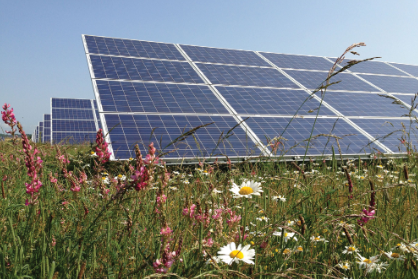
The Ouse Valley Solar Farm will follow a similar not-for-profit model: local ownership, local decision-making, and local benefit.
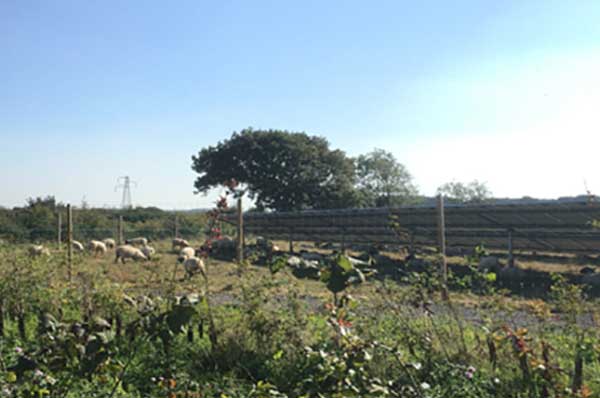
Visual Impact
How the solar farm will look
We’ve thought carefully about how the solar farm will sit within the local landscape. The site is naturally screened to the north by tree canopies and hedgerows, which helps it blend into its surroundings. While parts of the solar farm will be visible from the public footpath, we’re taking steps to reduce its visual impact as much as possible.
A professional landscape and visual impact assessment has been carried out, and the findings are being used to shape the final design, making sure we address any areas of concern in a considered and informed way.
Nature & Biodiversity
One of the real benefits of a solar farm is that taking the fields out of arable rotation gives nature a chance to recover and thrive, and based on what we’ve seen at Meadow Blue Community Energy Solar Farm, which achieved nearly 200% biodiversity net gain, we expect the same for OVSF.
We commissioned a full Ecological Assessment, including a Preliminary Biodiversity Net Gain Assessment, to make sure our plans are grounded in evidence and best practice. The findings are shaping everything from planting decisions to habitat design.
The site’s existing hedgerows are already rich in species, and our plans include adding to them, filling gaps along boundary hedgerows to improve both wildlife corridors and natural screening. We’re also exploring habitat features such as bat boxes, bird boxes, bug hotels, and log piles across the site.

We’re also exploring habitat features such as bat boxes, bird boxes, bug hotels, and log piles across the site. A community meadow and a dedicated area to encourage ground-nesting birds are among the ideas we’re looking to bring to life.
What Happens Next
The project is currently moving through development stages.
A community investment offer is expected to launch after the solar farm is constructed, when local residents will be invited to invest and become members in the community benefit society.
If you’d like to stay informed about progress and learn more about how to get involved, please get in touch via the Contact Us page.
Building the solar farm
The solar farm would take around four months to build, with specialist contractors managing every stage of the work. During this time, we’d put up a stock fence and security cameras for safety.
We know that construction can be disruptive, especially when it comes to traffic. An approved traffic management plan would be in place, keeping any impact on local roads to a minimum and making sure everything meets local requirements, and respects local people and spaces.
Once the solar farm is up and running, there’d be very little coming and going, just the occasional maintenance visit over its expected lifespan.
Archaeology
All archeologically sensitive areas will be identified, and appropriate mitigation considered within design.
Public Footpath
No public rights of way will be removed or diverted as a result of the proposal. All appropriate safety measures will be in place during construction.
Education
An education area is proposed adjoining the footpath next to a community meadow.
Flood Risk
A topography survey is being undertaken. A flood risk assessment and drainage strategy will be implemented to mitigate or avoid potential flood issues.